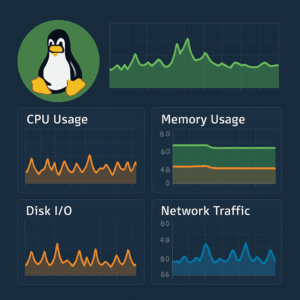
The Importance of Server Monitoring Keeping Your Site Up and Running
Detect incidents before users do (and before SEO suffers)
When a website starts getting real traffic, your server runs closer to capacity — and small issues become outages: a full disk, a memory leak, a broken database connection, an expired SSL certificate. Server monitoring is how you catch problems early, reduce downtime, and keep performance stable.
Monitoring is valuable on any hosting, but it becomes essential on VPS hosting where you control the OS, services, and security. Whether you run Linux VPS or Windows VPS, monitoring creates the safety net that keeps your site up and running.
What “server monitoring” includes in practice
Good monitoring is not one tool — it’s a set of signals that answer four questions:
Is it up? (availability / uptime checks)
Is it fast? (performance metrics, latency, throughput)
Is it safe? (security events, auth failures, unusual traffic)
Is it sustainable? (capacity planning, resource headroom, error budgets)
The four core monitoring signals
Signal
What it tells you
Examples
Best use
Metrics
Trends and thresholds
CPU, RAM, disk latency, 5xx rate
Alerts, capacity planning
Logs
What happened (details)
Nginx errors, auth logs, DB errors
Root cause analysis
Traces
Where time is spent
Slow endpoints, DB calls per request
Performance debugging
Uptime checks
External availability
HTTP checks, synthetic login
Know before customers complain
Why you need to monitor the health of servers
Manual checks don’t scale. A sysadmin can’t continuously inspect CPU graphs, logs, disk usage, and security events for every server — especially in growing companies. Automated monitoring helps you respond fast and prevent silent failures.
Monitoring benefits
Faster troubleshooting (reduce downtime and revenue loss)
Better performance (optimize using real data)
Improved security (detect attacks and abnormal behavior early)
Capacity control (know when to scale CPU/RAM/storage)
What to monitor on a VPS: practical checklist
This is a high-ROI baseline for most websites, APIs, and mail servers.
Infrastructure and OS
CPU usage and load average (sustained peaks, not short spikes)
Time drift (incorrect time can break SSL and authentication)
Services and application layer
Web server health: Nginx/Apache/IIS up, worker saturation
HTTP status distribution: 2xx/3xx/4xx/5xx (watch 5xx spikes)
Database health: connections, slow queries, locks
Queue workers (if used): backlog size, processing time
SSL certificate expiry and HTTPS availability
Business-critical signals
Checkout/payment flow availability (synthetic transaction if e-commerce)
Form submissions / lead events (are they arriving?)
Mail delivery health (if you run email): queue size, auth failures (VPS mail server)
Alerting that helps (not alerting that creates noise)
Monitoring fails when alerts are either too noisy (people ignore them) or too quiet (incidents happen silently). Good alerting focuses on symptoms users feel, then drills down.
Alerting rules of thumb
Alert on user impact: downtime, 5xx errors, p95 latency spikes.
Use thresholds + duration: “disk > 90% for 10 minutes”, not “disk > 90% once”.
Separate warning vs critical: warnings for capacity planning, critical for incidents.
Add runbooks: every alert should link to “what to check first”.
Route alerts properly: mail + messenger + on-call rotation. Email notifications can be handled via your mail stack (or separate mail server VPS).
ELK / OpenSearch stack: log aggregation and search.
APM tools (optional): deeper performance tracing for apps.
On a small project, you can start simple: uptime checks + basic host metrics + log rotation and alerts. As you scale, add log aggregation and tracing.
Incident response: what to do in the first 15 minutes
Confirm impact: uptime check, real user reports, error rates.
Check “big three”: CPU, RAM/swap, disk usage + disk latency.
Review recent changes: deployments, config edits, DNS updates, certificates.
Inspect logs: web server + app + database for correlated errors.
Stabilize: restart failing services, scale resources, roll back risky changes.
Document: timeline, root cause, fix, and prevention steps.
Typical monitoring mistakes that cost uptime
Monitoring only CPU and ignoring disk latency and memory pressure.
No alerts for SSL/domain expiry (avoidable outages).
No log retention (no evidence when incidents happen).
No backup monitoring (backups fail silently without alerts).
Alert noise (teams stop reacting because alerts are constant).
If your project is growing, monitoring becomes a core part of reliability. For stable performance and full control, consider Cube-Host VPS hosting with the OS you need: Linux VPS or Windows VPS.